Scroll II
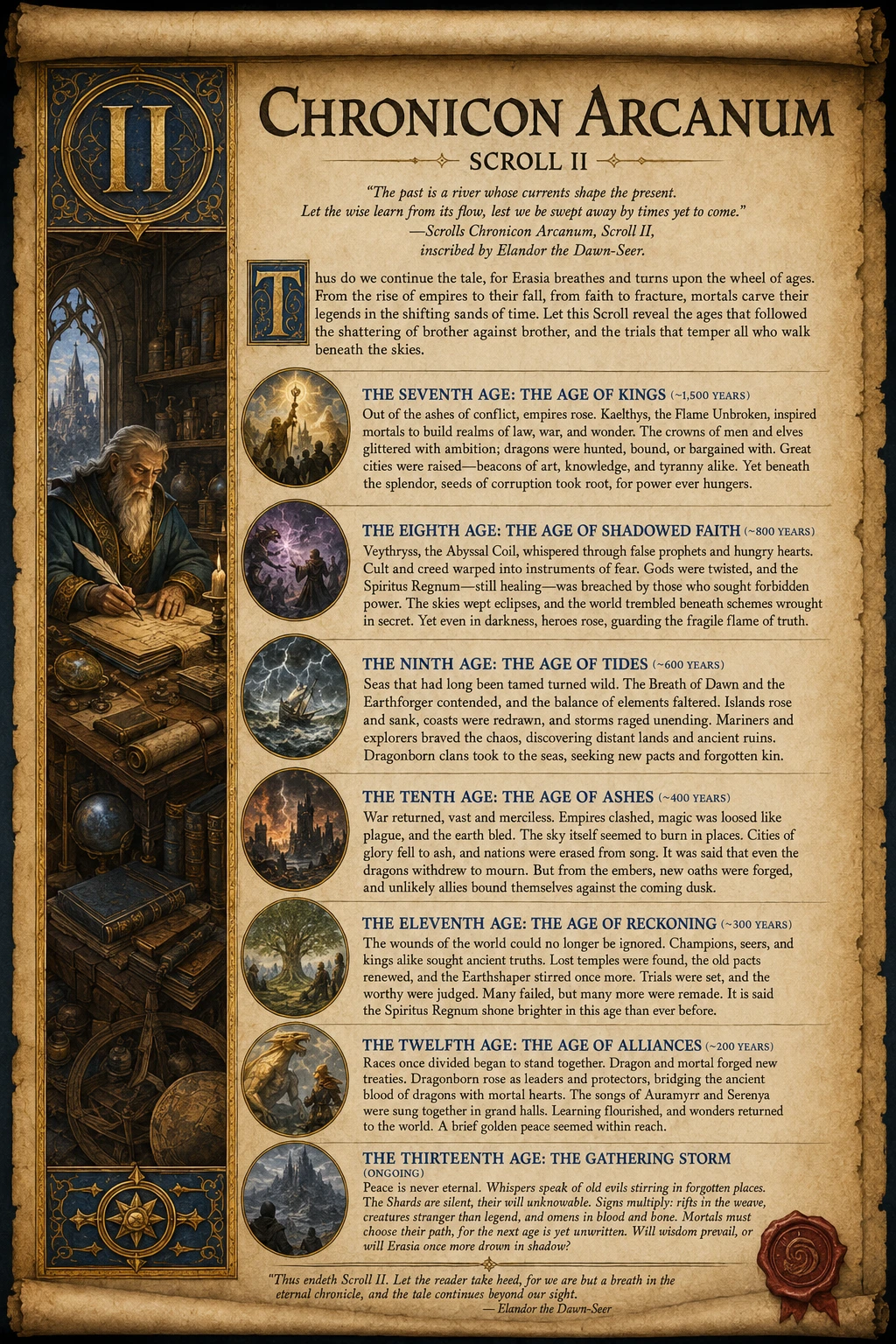
To measure eternity is folly, yet the wise may sketch shadows of the truth. Thus, let us reckon the Ages, as the Shards themselves unfolded them.“
— Chronicon Arcanum, Scroll II, inscribed by Elandor the Dawn-Seer, First Chronicler of the Temples at the cusp of the Sixth Age.
Harken once more, o seekers of the veiled past! I am Elandor, humble scribe of the Dawn Temples, who hath delved deeper into the embers of memory, drawing forth the threads of strife and ambition that wove the latter Ages. In this second scroll, I illuminate the tumults of the Sixth Age—the Age of Mortals—wherein the fragile sparks of life, once mere echoes of divine whim, seized the forge of destiny. From the whispers of Serenya and the echoes preserved in the halls of the Elrieth Collective, I recount the Expansion Era, that fevered span of conquest and schism, where races clashed like hammers upon anvil, birthing empires from blood and ambition. Attend, for these are the breaths of mortal fire, kindled amid the lingering shadows of the gods.
The Sixth Age: The Age of Mortals (~2,000–3,000 years)
Now mortals claimed the reins! Kingdoms rose like flames from tinder, religions flourished as balm to weary souls, and wars thundered in the names of forgotten shards. In the northeastern wilds, the dragons and their Dragonborn descendants united during the Expansion Era, forging the mighty Drakonar Empire—a realm of scaled spires and fiery forges, where wyrm-lords ruled with ancient wisdom and unyielding might. Yet shadows lingered: some 700 years past, Gogran stirred once more, his First Awakening unleashed by desperate Jehionians seeking Jehion’s return. Havoc gripped the Kingdom of Weshal, but the Shimmerforce—three valiant souls—defeated him, birthing Shimmerism and its creed of mortal resilience. Gogran’s Second Awakening looms even now, Jehion whispers from the Regnum’s veil, and the Six cast long shadows over our fragile progress.
Ah, but let us delve into the Expansion Era itself, that crucible of divergence wherein the Jehionians, once exalted bearers of divine lore, fell into disdain. Mistreated by kin and stranger alike—even by humans, their erstwhile brethren—the Jehionians clung obsessively to Jehion’s ancient teachings, while others gazed toward progression. This schism of souls birthed new nations: humans scattered into kingdoms like Weshal, mercantile states, and feudal realms; elves forged their identities, with Selanar Elrieth uniting the southern clans through arcane prowess and silvered tongue, birthing the Elrieth Collective and its Council of Seasons, named in his honor; dwarves endured their own Schism, cleaving into the pragmatic Stonebound of Khazrondor and the zealous Forgekeepers of the Nernboldar Dominion, each claiming the true mantle of endurance. Tieflings, orcs, gnomes, and others carved their fates amid this flux, founding merchant empires like Kael’rathis and Zerathos, as well as Gorr’Vatra and Thechnocratic Republic of Gnomeregia, where trade bridged the chasms of enmity.
Yet progress bred a peril most foul. Magic, once the Jehionians’ guarded flame, spread like wildfire, fueling arcane forges, enchanted airships, and weaponry that scarred the lands. Mortal hubris, unfettered by divine wisdom, birthed the Mage Wars—a protracted age of unchecked sorcery where fledgling empires weaponized the arcane, turning fertile vales into expanses of glass and ash. The zenith of this madness culminated in the Diversity Calamity. Arrogant scholars, thirsting for ultimate supremacy, sought to splice the graceful, natural magics of Jehion with the chaotic, infernal energies forged by Gogran. This blasphemous union tore the very weave of creation, unleashing arcane storms that leveled city-states and wrought grotesque mutations upon those who dared wield it.
Seeing Erasia teeter upon the precipice of annihilation, a small, isolated society of wise scholars stepped forth from the shadows. Thus was born the Arcanum Omnis, the grand Order of mages. Casting aside mere study, they took up the mantle of supreme arbiters, violently quelling the rogue warlords and decreeing strict laws upon the weave. To seal the scars of the Calamity, these founders gathered the darkest incantations and bound them within three forbidden tomes: The Book of Victims, the Book of Heretics—housing spells of the old gods and demonic spells of Gogran—and the Book of the Benevolent. Hid away by the oldest of scholars, these texts became legend, and the Arcanum Omnis stood as the eternal watchmen of magic.
Amidst these arcane upheavals, other localized conflicts erupted: the War of Elven Unification, where Selanar’s vision quelled warring clans beneath the Collective’s banner; the Tiefling-Dwarven War, a blaze ignited fifty years after Gogran’s resealing, wherein ancient grudges—fueled by the Schism and the stigma of Gogran’s infernal touch—led to five years of brutality in Avetope and southwestern Weshal. Dwarven armies, fragile allies from both Khazrondor and Nernboldar, clashed with Tiefling guerillas, culminating in the desperate near-unleashing of the Eye of Magalesh, a cataclysmic relic split and hidden in Jehionian ruins to seal the fragile Cease-Fire of Weshal. The deaths of Tordek Burrowfound and Qemuel Ecstasy, scholars of peace slain in a shadowed tavern blast, became emblems of lost harmony, their unavenged end stoking the fires of vengeance.
Shimmerism, born from the Shimmerforce’s sacrifice, evolved from creed to faith, emphasizing mortal agency against divine tyranny. Yet it too fractured: the Shimmerian Schism saw the Followers of Shimmerism clash with Galonian monarchs, birthing the Holy Dominion of Shimmerhold—a theocratic bastion ruled by the Shimmerian High Council from Sanctum Lux, its Sanctified Legions enforcing doctrine with inquisitorial zeal. Anti-Jehionian fervor swelled, marginalizing the old faithful into enclaves, while arcane pollution and resource wars hinted at woes to come. Thus the Expansion Era waned, its legacy a tapestry of empires risen and scars etched deep, paving the path for mortal ascendancy amid divine whispers.
Within this Sixth Age, however, lies the shadowed prelude known as the Alabaris Era and the Taming of the Wilds (~250 years, circa 2,250–2,000 years ago), a forge-fire of mortal mettle that birthed our modern world from primal chaos. Alabaris—that ancient epithet, drawn from Auramyrr’s draconic canticles, evoking “The Fractured Dawn”—was the cradle of our races’ infancy, a world still quaking from the Fifth Age’s tremors. The Creatura Nihilo, reshaped by divine hands yet untempered by trial, fumbled toward footing: humans in mud-thatched steadings invoked Kaelthys for tribal raids; elves etched moonlit runes in sylvan glades, Serenya’s echoes guiding their longevity; dwarves hammered holds into Drokath’s bones, their forges ringing like oaths unbroken. Orcs and tieflings, scarred by Gogran’s forge, roamed as warbands or shadowed cabals, while gnomes tinkered with crystal-traps in burrow-cities, and halflings wove hearth-tales in river-vales[cite: 2]. Dragonborn, fierce bridges ’twixt wyrm and walker, kindled flame-altars in volcanic lairs, their breaths a defiant hymn to the Dragonlike Shards.
Yet Alabaris was no idyll; it was a mosaic of strife, where fledgling kingdoms bruised against one another like unripe fruit. The nascent Galonian Empire, whelped from Galon I’s iron-willed confederation of human warlords, gazed hungrily at the Wilds—that colossal, unclaimed maw devouring Alabaris’s midriff. A labyrinth of fog-wreathed badlands, carnivorous thickets, and leviathan-haunted coasts, the Wilds were the gods’ unfinished jest: relics of the Tlālōtlālli jutting like broken teeth, elemental rifts spewing aberrants, and Veythryss’s voids yawning to swallow the unwary. To the Galonians, it was destiny’s dowry—untapped veins of star-iron, groves of eternal timber, and leylines humming with unbound arcana, ripe for imperial grasp.
Thus dawned the corporate dawn. Over sun-scorched decades, Galon I’s edicts spawned the Wilds Corporations, engines of ambition unshackled from creed or caste. Rivenshield’s green-gold banners staked claims on gem-hoards, their mercenaries felling treants for shipwrights’ keels. Argent Concord’s blue-sashed knights erected thorn-crowned forts, taxing beast-pelts as “crown’s due.” Luminarch’s white-crimson inquisitors torched “blasphemous” groves, unearthing sanctified relics amid pyres. Verdant Oath’s leaf-woven wardens mediated with fey-pacts, harvesting without hemorrhage. Auric Horizon’s black-gold dreamers, last to the fray, mapped the veiled with compass and quill, luring exiles with legends unborn.
Two centuries of crucible followed—a saga etched in bloodied ledgers and half-buried bones. Initial forays were folly’s feast: Concord caravans bogged in mimic-marshes, Syndicate pyres drawing draconic ire, Rivenshield delvers awakening burrow-tyrants. Gnomish contraptions exploded in humid fury; orcish shock-troops bartered with storm-giants for safe passage, only to be betrayed by lightning’s whim. Yet adaptation was mortal’s blade: tiefling warlocks bound imps to scout rifts, elven illusionists cloaked supply-lines in phantom herds, and dragonborn pyromancers cauterized plague-vines with breath-weapons. The Great Accord of the Veil, sealed at fog-shrouded Fortress Atoria under Galon II’s aegis, fused foes into fellowship—Verdant elixirs quenched fever-mists, Luminarch lit eternal watch-fires, Horizon’s charts unveiled chokepoints. The Trans-Wilds Convoy, a thunder of air-barges and steam-beasts, breached the heartland; the Starlit Expanse’s fall yielded auroral alloys, the Thornveil’s yielding birthed alchemical blooms.
Victory’s veil lifted ~2,000 years ago, the Wilds yielding like a tamed hart. Alabaris, mended in forge and furrow, donned the mantle of Erasia—“The Enduring Harmony”—as provinces bloomed from badlands, rails lacing the land like Drokath’s veins. The Galonian Empire, engorged, stretched from tundra to tide, its spires piercing the sky. Corporations, alchemized by triumph, pivoted: Rivenshield to trade-lords, Concord to courtly schemers, Luminarch to temple-builders, Verdant to crown-gardeners, Horizon to lore-keepers. But the Wilds’ ghost endures—fey-reavers stalk forgotten fringes, corporate vaults guard pacts with the devouring dark—a caution that harmony is hewn, not given.
Thus ends this second scroll, etched in the flickering light of Kaelthys’ flame. May these words guide thee through the mists of ambition, o reader, as they have illumined my vigil. For in knowing our strifes, we glimpse the forge of our endurance—and perhaps, in time, mend what was sundered.