Scroll I
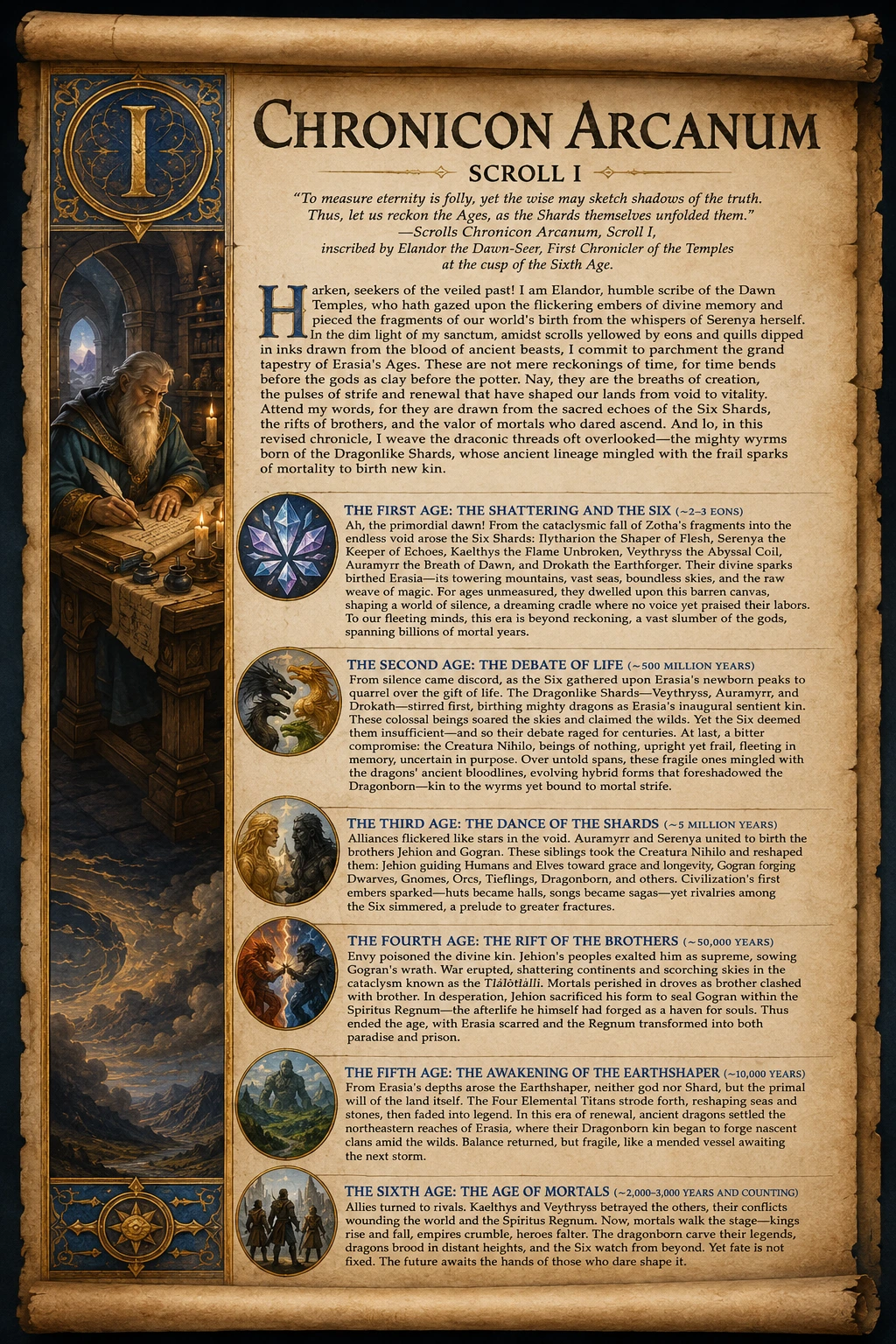
‘To measure eternity is folly, yet the wise may sketch shadows of the truth. Thus, let us reckon the Ages, as the Shards themselves unfolded them.’
— Scrolls Chronicon Arcanum, Scroll I, inscribed by Elandor the Dawn-Seer, First Chronicler of the Temples at the cusp of the Sixth Age.
Harken, seekers of the veiled past! I am Elandor, humble scribe of the Dawn Temples, who hath gazed upon the flickering embers of divine memory and pieced the fragments of our world’s birth from the whispers of Serenya herself. In the dim light of my sanctum, amidst scrolls yellowed by eons and quills dipped in inks drawn from the blood of ancient beasts, I commit to parchment the grand tapestry of Erasia’s Ages. These are not mere reckonings of time, for time bends before the gods as clay before the potter. Nay, they are the breaths of creation, the pulses of strife and renewal that have shaped our lands from void to vitality. Attend my words, for they are drawn from the sacred echoes of the Six Shards, the rifts of brothers, and the valor of mortals who dared ascend. And lo, in this revised chronicle, I weave the draconic threads oft overlooked—the mighty wyrms born of the Dragonlike Shards, whose ancient lineage mingled with the frail sparks of mortality to birth new kin.
The First Age: The Shattering and the Six (~2-3 eons)
Ah, the primordial dawn! From the cataclysmic fall of Zotha’s fragments into the endless void arose the Six Shards: Ilytharion the Shaper of Flesh, Serenya the Keeper of Echoes, Kaelthys the Flame Unbroken, Veythryss the Abyssal Coil, Auramyrr the Breath of Dawn, and Drokath the Earthforger. Their divine sparks birthed Erasia—its towering mountains, vast seas, boundless skies, and the raw weave of magic. For ages unmeasured, they dwelled upon this barren canvas, shaping a world of silence, a dreaming cradle where no voice yet praised their labors. To our fleeting minds, this era is beyond reckoning, a vast slumber of the gods, spanning billions of mortal years.
The Second Age: The Debate of Life (~500 million years)
From silence came discord, as the Six gathered upon Erasia’s newborn peaks to quarrel over the gift of life. Though forests teemed and beasts roamed, the world lacked voices to remember and worship. Yet ere the full storm of their words, the Dragonlike Shards—Veythryss, Auramyrr, and Drokath—stirred first, birthing the mighty dragons as Erasia’s inaugural sentient kin. These colossal beings, scaled in midnight void, radiant gold, and living stone, soared the skies and claimed the wilds, embodying the raw cosmic forces of their makers: hungering shadows, harmonious dawn, and enduring earth. Their roars were the first echoes of awareness, a prelude to greater creation. But the Six deemed them insufficient—too primal, too aloof from mortal frailty—and so their debate raged for centuries—a storm of fire, song, stone, and shadow—revealing each Shard’s essence and flaws. At last, a bitter compromise: the Creatura Nihilo, beings of nothing, upright yet frail, fleeting in memory, uncertain in purpose. They wandered the wilds, bearing Auramyrr’s First Song in trembling chants, loving and fearing, building and breaking. Over untold spans, these fragile ones mingled with the dragons’ ancient bloodlines, much as Auramyrr and Serenya would later unite in divine congress, evolving hybrid forms that foreshadowed the Dragonborn—humanoid scions of scale and fire, kin to the wyrms yet bound to mortal strife. Yet the gods grew restless, for their creations were imperfect, hollow echoes of Zotha’s wholeness.
The Third Age: The Dance of the Shards (~5 million years)
Alliances flickered like stars in the void. Auramyrr and Serenya, bound by harmony and memory, united to birth the brothers Jehion and Gogran—embodiments of creation’s contradictions. These siblings took the Creatura Nihilo and reshaped them: Jehion guiding Humans and Elves toward grace and longevity, Gogran forging Dwarves, Gnomes, Orcs, Tieflings, Dragonborn, and others in the fires of endurance and strife. The Dragonborn, already seeded from draconic minglings, were perfected here as a humanoid race alongside the standard draconic behemoths of D&D lore—fierce guardians of ancient pacts, their breaths echoing the Dragonlike Shards’ might. Civilization’s first embers sparked—huts became halls, songs became sagas—yet rivalries among the Six simmered, a prelude to greater fractures.
The Fourth Age: The Rift of the Brothers (~50,000 years)
Envy poisoned the divine kin. Jehion’s peoples exalted him as supreme, sowing Gogran’s wrath. War erupted, shattering continents and scorching skies in the cataclysm known as the Tlālōtlālli. Mortals perished in droves as brother clashed with brother. In desperation, Jehion sacrificed his form to seal Gogran within the Spiritus Regnum—the afterlife he himself had forged as a haven for souls. Thus ended the age, with Erasia scarred and the Regnum transformed into both paradise and prison.
The Fifth Age: The Awakening of the Earthshaper (~10,000 years)
The wounded world stirred from its slumber. From Erasia’s depths arose the Earthshaper, neither god nor Shard, but the primal will of the land itself—guardian of elements, balancer of all. The Four Elemental Titans strode forth, reshaping seas and stones, then faded into legend. Dwarves, forged by Gogran yet rooted in Drokath’s endurance, split their faith: the Forgekeepers clung to their creator’s shadowed legacy, while the Stonebound turned to the Earthshaper as their true foundation. In this era of renewal, the ancient dragons, ever aloof, settled the northeastern reaches of Erasia, claiming jagged peaks and shadowed vales as their domains, where their Dragonborn kin began to forge nascent clans amid the wilds. Balance returned, but fragile, like a mended vessel awaiting the next storm.
The Sixth Age: The Age of Mortals (~2,000–3,000 years)
Now mortals claimed the reins! Kingdoms rose, religions flourished, and wars echoed in the gods’ names. In the northeastern wilds, the dragons and their Dragonborn descendants united during the Expansion Era, forging the mighty Drakonar Empire—a realm of scaled spires and fiery forges, where wyrm-lords ruled with ancient wisdom and unyielding might. Yet shadows lingered: some 700 years past, Gogran stirred once more, his First Awakening unleashed by desperate Jehionians seeking Jehion’s return. Havoc gripped the Kingdom of Weshal, but the Shimmerforce—three valiant souls—defeated him, birthing Shimmerism and its creed of mortal resilience. Gogran’s Second Awakening looms even now, Jehion whispers from the Regnum’s veil, and the Six cast long shadows over our fragile progress.
The Seventh Age: The Age of the Mortal Gods (~700 years ago – present)
Lo, the pinnacle of mortal glory! In that dark hour of Gogran’s unleashing, the Shimmerforce—Kaelion the paladin, Liriel the ranger, and Thorgrim the druid—sacrificed all to reseal the demon, their lives woven into the Regnum’s fabric. The Six bowed in awe, crowning them the Mortal Gods, throned beside Jehion as eternal guardians. This age is ours, fragile yet defiant: mortals ascend, Shimmerism preaches unity against tyranny, and the Three shimmer against the encroaching void. Yet whispers persist—Gogran strains, and the Earthshaper stirs when balance falters. Will this era endure, or shatter like those before?
Thus ends my chronicle, etched in the fading light of Auramyrr’s dawn. May these words guide thee, o reader, as they have guided me through the mists of forgetting. For in knowing our Ages, we honor the Shards—and perhaps, in time, become shards ourselves.