The Fractured Dawn and the Birth of a Bastion
Alabaris Era, ~2,250–2,000 Years Ago
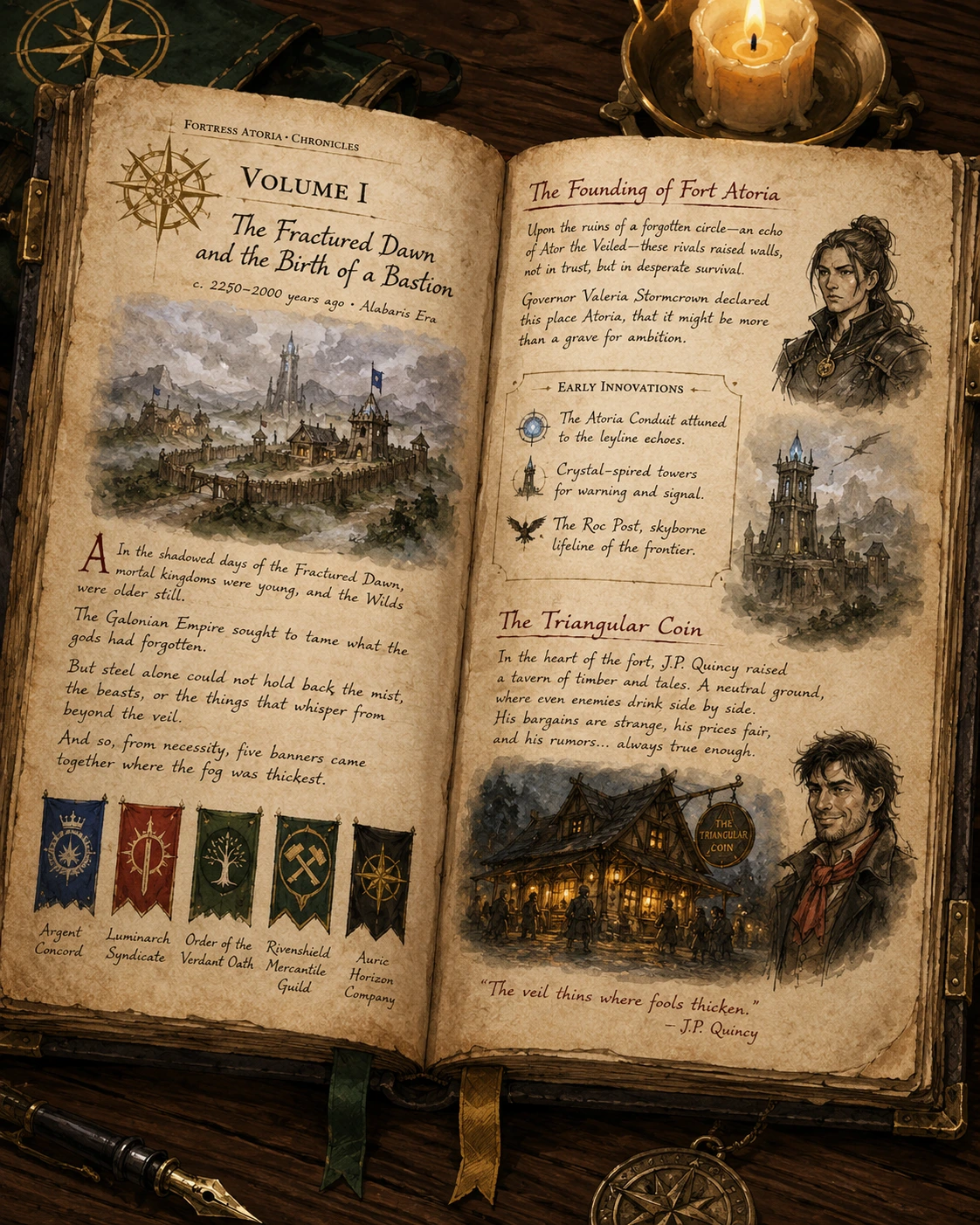
In the shadowed prelude of the Alabaris Era—when the world still bore the draconic epithet “The Fractured Dawn,” a mosaic of nascent kingdoms clawing for survival amid the gods’ lingering scars—Fortress Atoria emerged not as a grand edifice of stone and ambition, but as a desperate improvisation born of mortal peril and improbable camaraderie. The Wilds, that colossal maw of mist-shrouded badlands, carnivorous thickets, and leviathan-haunted coasts, had long defied the young Galonian Empire’s covetous gaze. Emperor Galon I, unifier of fractious human warlords, decreed the taming of this untamed heartland as the empire’s manifest destiny, spawning the Wilds Corporations as engines of conquest. Yet the frontier’s horrors—aberrant rifts spewing shadow-wraiths, mimic-marshes swallowing caravans whole, and Veythryss’s voids yawning like forgotten sins—demanded more than steel and avarice; they required a fulcrum of fragile unity, a place where ambition could temper into alliance without immediate fracture.
Thus, circa 2,250 years ago, amid the Fogveil Marches’ thorn-choked fringes—a fog-veiled hollow where leyline echoes hummed like half-remembered Auramyrr songs—the provisional bastion of Fort Atoria took shape. Its founding was no imperial fanfare, but a gritty convergence of necessity: a Horizon scouting party, harried by mimic-hounds, stumbled upon a crumbling Tlālōtlālli ruin—a circular stone dais etched with dormant runes, later revealed as the Atoria Conduit, a relic of a forgotten golden age’s portal network. Desperate for shelter, they raised thorn-walls from scavenged Verdant Oath vines and hammered stakes with Rivenshield-forged nails, only for a Luminarch purge-team to arrive, mistaking the site for a “void-nest.” Blood nearly spilled that mist-shrouded dawn, but a Concord knight—ever the mediator—sheathed his blade, proposing a pact: share the ruin’s shelter, or perish divided. Governor Valeria Stormcrown, a tiefling-blooded human legionnaire with a warlock’s shadowed intuition, was dispatched from proto-Cardvale to arbitrate; her iron decree christened the site “Atoria,” invoking Ator the Veiled, the half-forgotten elven cartographer whose illusory wards had once shielded a doomed expedition from the very fogs that now cloaked their labors.
The fort’s earliest days were etched in mud, blood, and barter—a ramshackle sprawl of timber palisades lashed from Thornveil hardwoods, crystal-spired watchtowers attuned to the Conduit’s leylines by opportunistic gnomish tinkerers, and earthen berms reinforced with dwarven slag from Rivenshield’s nascent quarries. Stormcrown’s ad-hoc garrison swelled with corporate cast-offs: Horizon dreamers charting veiled passes from fog-wreathed parapets, their golden compasses glinting like defiant stars; Oath rangers weaving root-wards to repel ent-assaults; Syndicate inquisitors consecrating the Conduit with dawn-rites to banish its “echo-haunts”; Concord knights drilling tax-ledgers amid the muck; and Rivenshield sellswords hauling crystal-veins for makeshift forges. Innovations sprouted from this chaos: the Roc Post, born when a clutch of Storm Roc eggs tumbled from nearby crags during a Veilfog quake—rather than destroy them, Stormcrown ordered their secret taming, her pragmatic vision birthing the fort’s skyborne lifeline.
Yet Atoria’s soul was forged not in stone, but in the flickering hearths of its emergent neutral heart: the Triangular Coin, the city’s inaugural tavern and enduring enigma. Erected ~2,240 years ago in the fort’s nascent market hollow—a triangular timber longhouse roofed with mimic-hide (a grim trophy from the Veilfog Incursion)—it arose from the whims of its founder, J.P. Quincy, a enigmatic wanderer whose arrival remains swathed in as much fog as the Marches themselves. Quincy, then a scarred explorer in his vigorous thirties, washed ashore from a botched Wilds delve: long black hair matted with thorn-sap, a crimson scarf (rumored woven from a slain wyrm’s vein-threads) knotted at his throat, and hands already bearing the curse of three fingers each—lost, he claimed with a wry grin, to “the Wilds’ generous bite” during a shadow-plague that claimed his band. No mere survivor, Quincy was outgoing alchemy and eccentric fire: a storyteller whose proverbs danced like fireflies (“The veil thins where fools thicken”), a host who poured exotic brews from Thornveil fungi and ember-wolf haunches, and a collector whose bar-shelf brimmed with oddities—a humming dagger that pointed to forgotten norths, a bottled thunder that rattled like Gogran’s distant growl.
Quincy’s founding of the Coin was no accident; whispers persist he struck a “bargain with the land itself”—fingers and fate traded for the tavern’s uncanny neutrality, a bubble where corporate venom dissolved into shared ale. In those formative nights, as corporate envoys bartered over Conduit attunements, the Coin’s triangular rumor-board—carved from Shattered Peaks bone and pinned with riveted scraps—became Atoria’s pulse: Horizon scouts etching hex-whispers, Oath herbalists trading blight-cures for posts, Syndicate zealots decrying “void-taints” in crimson ink. Brawls erupted like summer storms—Concord blue-bloods clashing tankards with Rivenshield roughnecks—but Quincy’s intervention was legend: a terrifying glare, a whispered proverb, or the subtle flash beneath his scarf (some swear a Fey-glimpsed relic, others a shard of the Conduit itself), quelling flames without a drop spilled. His eccentricity endeared him: he’d cover a pauper’s tab with a riddle-quest (“Fetch me a flamefruit from ash-trees that burn eternal”), rewarding successes with “overpaid” trinkets—a scarf of shifting colors that dreamed of undiscovered hexes, or an obsidian coin that flipped on edges, defying chance.
The Coin’s rise mirrored Atoria’s: from mud-floored hovel to neutral sanctum, it hosted the Great Accord of the Veil (~2,200 years ago) in its smoke-hazed rafters, where Quincy’s “mystery roast” (whispers say laced with truth-serum spores) lubricated oaths amid the thrum of the awakening Conduit below. As the two-century taming ground on, the tavern absorbed the fort’s scars—walls pocked with bolt-marks from Syndicate purges, floors stained from Oath entangle-spills—yet Quincy’s outgoing charm held it sacred: a place where a Luminarch might share a bench with a Horizon dreamer, bound by the board’s wild exaggerations and the ale’s forgiving haze. By the Wilds’ yielding (~2,000 years ago), as Alabaris reforged into Erasia, the Triangular Coin stood as Atoria’s beating heart—a mysterious fulcrum where Quincy’s eccentric longevity (unchanged, save deeper scars) hinted at bargains deeper than bone, ensuring the fort’s fragile unity endured beyond imperial decree.
This foundation—Stormcrown’s pragmatism, the Conduit’s arcane whisper, the Roc’s thunder, and Quincy’s enigmatic hearth—cemented Atoria as more than bulwark: a living forge where mortals mended veils with grit and grog, birthing the city’s motto: “Veils Break, Atoria Endures.”